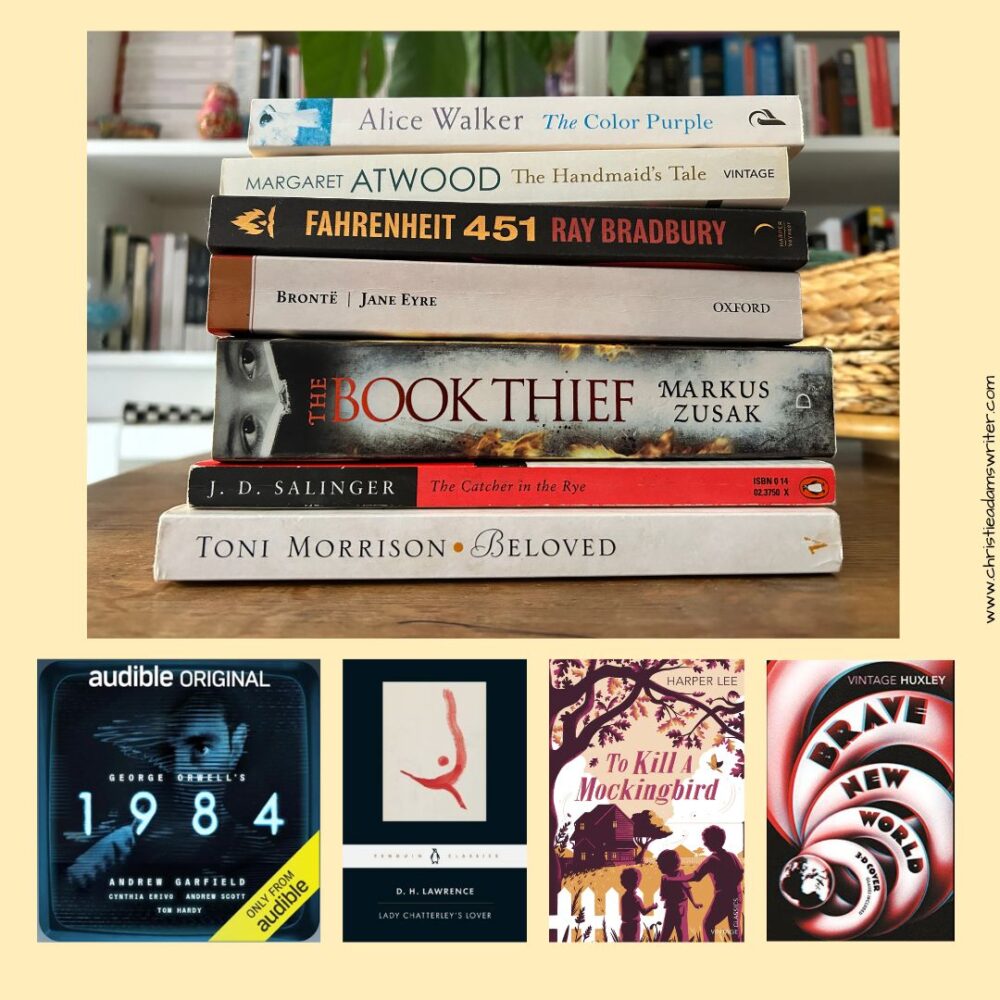
What would you do if someone told you that you weren’t allowed to read a book?
Throughout history, books have been banned, challenged, censored or removed from libraries and schools for all sorts of reasons.
Sometimes it’s because of sex, violence or language. Sometimes it’s religion, politics or ideas that challenge the beliefs of the people trying to suppress them.
With that in mind, here are ten of my favourite books that have faced censorship, bans or challenges.
1. The Handmaid’s Tale by Margaret Atwood
Margaret Atwood’s dystopian novel has repeatedly been challenged in schools and libraries. A book in which women are forbidden to read has itself been censored.
It’s my most recommended read here, other than my favourite bonus book.
Its themes of reproductive control, religion, sexuality, violence and the oppression of women have made it controversial and scarily relevant.
2. 1984 by George Orwell
George Orwell’s vision of a totalitarian society is probably one of the most recognisable dystopian novels ever written.
It explores surveillance, propaganda, censorship and the manipulation of truth. Unsurprisingly, those themes have made it controversial in different political and cultural contexts, and the book has faced multiple ongoing bans and challenges.
The idea of a government controlling what people know feels particularly relevant in our current climate.
3. The Color Purple by Alice Walker
Alice Walker’s Pulitzer Prize-winning novel explores racism, poverty, abuse, sexuality and the experiences of Black women in early twentieth-century America.
Those subjects have also made it a frequent target, particularly in educational settings.
It’s a reminder that books can be criticised or even feared precisely because they deal with difficult subjects that other people believe are important to discuss.
4. Beloved by Toni Morrison
Toni Morrison’s Beloved is a powerful novel about slavery and its psychological aftermath.
It contains graphic violence, sexual abuse and disturbing subject matter, which has resulted in numerous attempts to restrict its availability.
Morrison’s work is interesting in the context of censorship because the ‘difficult’ material is integral to the story being told.
5. The Catcher in the Rye by J.D. Salinger
Salinger’s telling of the haunting Holden Caulfield and his teenage alienation has been controversial almost since its publication.
Challenged for its language, sexual references and themes considered inappropriate for younger readers.
Despite this, it has remained a hugely influential coming-of-age novel. Also readable in one sitting.
6. To Kill a Mockingbird by Harper Lee
Harper Lee’s classic novel examines racism and injustice in the American South through the eyes of a child.
Critics seem to focus on its racist language, violence and sexual content, which creates an interesting contradiction at the heart of many censorship debates. After all, a book may contain offensive language or ideas because it is depicting prejudice, rather than endorsing it. Some literature must make us uncomfortable.
7. Fahrenheit 451 by Ray Bradbury
This one feels almost too perfect for a list about censorship. Ray Bradbury’s dystopian novel imagines a society in which books are forbidden and firemen are responsible for burning them.
The title itself refers to the temperature at which, according to the novel, books burn.
And yet Fahrenheit 451 has itself been challenged and censored. There’s something wonderfully ironic about that. I love this book.
8. Brave New World by Aldous Huxley
Aldous Huxley’s dystopian classic imagines a future society where people are controlled through technology, conditioning, pleasure and social conformity. Sound familiar?
The book has faced challenges relating to sexuality, religion, morality and drug use.
Like 1984 and Fahrenheit 451, it asks uncomfortable questions about what happens when individual freedom is sacrificed for social stability.
9. Lady Chatterley’s Lover by D.H. Lawrence
This is one of the most famous censorship stories in British publishing history. Lawrence’s novel was considered so sexually explicit that publication of the uncensored version was restricted for years.
In 1960, when Penguin Books published the complete text, they faced charges of obscenity. The jury found Penguin not guilty, and the trial became a landmark moment in the history of publishing and censorship. It also demonstrated just how dramatically attitudes towards literature can change.
10. The Book Thief by Markus Zusak
Set in Nazi Germany during the Second World War, it follows Liesel Meminger, a young girl who discovers the power of words and books in a world increasingly shaped by propaganda, censorship and persecution. Narrated by Death, it explores the importance of storytelling, the danger of controlling what people read, and the courage it takes to resist hatred.
Although the novel is widely loved, it has faced challenges in schools, including objections to its language and mature themes.
Its place on my list of banned and challenged books feels right, given its setting, a time when books were burned, ideas suppressed, and the written word treated as a threat.
Bonus Book – Jane Eyre by Charlotte Brontë
‘I am no bird; and no net ensnares me.’
One of my favourite literary quotes. I loved it so much I now have it tattooed!
Jane Eyre is a story about independence, self-respect and refusing to be defined or controlled by other people. Published in 1847, it challenged Victorian expectations of women, giving us a heroine who insists on her own identity, principles and freedom.
It has also faced challenges and criticism over the years, including objections to its religious themes and perceived moral and social transgressions.
For me, though, that quote is the heart of it. I am no bird. And no net ensnares me. Some words deserve to stay with you forever.
Why are books banned or challenged?
The reasons vary, but some themes appear again and again. Empowerment, sex, gender, violence, offensive language, religious themes, political ideas or independent thought, or material considered inappropriate for children.
But there’s a bigger question underneath all of this.
Who gets to decide what other people are allowed to read?
The history of banned books is so fascinating. The controversy isn’t always simply about the contents of a particular book. It’s also about freedom of expression, education, parental rights, cultural values and who has the authority, some would say audacity, to make those decisions.
Often, the books that cause the most controversy are the ones that force us to confront things we’d rather not think about.
Have you read any of these?
I’ve read most of these, some more than once. I’m working my way through the last couple.
Which one of these would you consider essential reading?
How do you feel about book bans?
Let’s have a conversation.
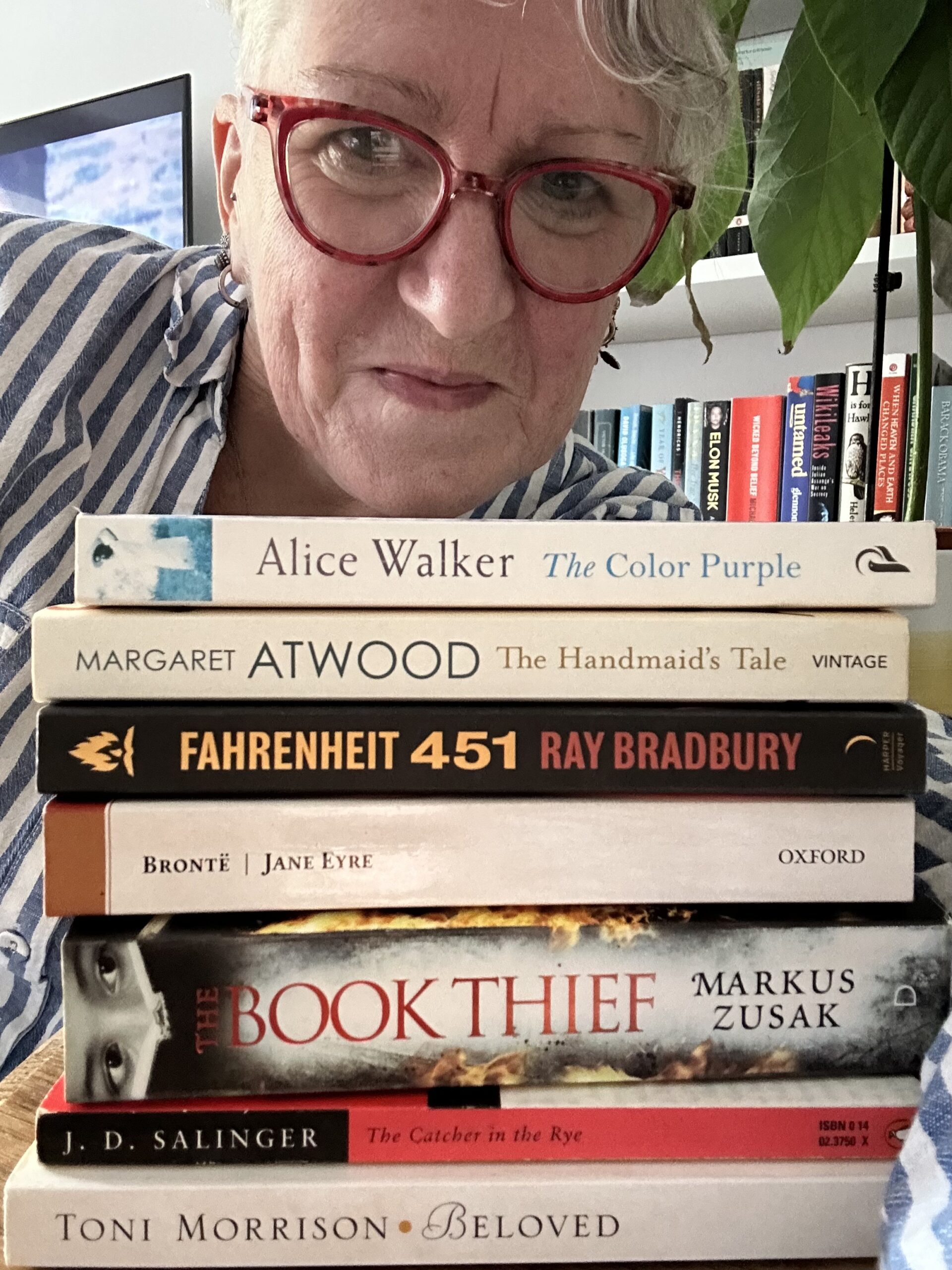
You will find all these books linked in my Amazon store. If you shop via the link, I will receive a small commission. You will not pay more, but it helps my business so I thank you.
https://www.amazon.co.uk/shop/christieadamswriter
https://www.amazon.com/shop/christieadamswriter
Substack, free and paid access options
https://substack.com/@christieadams
Writing fuelled by tea, and the 5am coffee
https://buymeacoffee.com/christieadamswriter
All my Links
https://www.christieadamswriter.com/click/
Recap to screen grab and save…
Banned Books They Don’t Want You to Read
The Handmaid’s Tale by Margaret Atwood
1984 by George Orwell
The Color Purple by Alice Walker
Beloved by Toni Morrison
The Catcher in the Rye by J.D. Salinger
To Kill a Mockingbird by Harper Lee
Fahrenheit 451 by Ray Bradbury
Brave New World by Aldous Huxley
Lady Chatterley’s Lover by D.H. Lawrence
The Book Thief by Markus Zusak
Jane Eyre by Charlotte Brontë
